Why Self-Employed Professionals in the UK Need an Accountant
The dream of self-employment in the UK is often built on the foundation of freedom: the ability to choose your clients, set your own hours, and be the master of your professional destiny. However, that freedom comes with a silent partner HMRC.
As your business grows, the administrative burden of self employed accounting can quickly transform from a minor weekend chore into an overwhelming source of anxiety. Many professionals attempt to juggle their own bookkeeping, tax filings, and compliance until a mistake happens, a missed deadline, an unexpected tax bill, or a rejected expense claim.
This guide moves beyond generic advice to provide clear, actionable answers for UK freelancers, contractors, and sole traders. Do you really need an accountant? When is the right time to hire one? And what are the actual risks of continuing to “go it alone”?
Understanding Self-Employed Accounting in the UK
To decide if you need professional help, you first need to understand the scope of the task. Self employed accounting is not merely “doing your taxes” once a year; it is a continuous cycle of financial management.
What Is Self-Employed Accounting?
It involves three core pillars:
- Income and Expense Tracking: Recording every penny earned and spent.
- Tax Calculation: Estimating your liability for Income Tax and National Insurance throughout the year so you aren’t blindsided in January.
- HMRC Compliance: Ensuring your records meet the legal standards required for “Making Tax Digital” and other regulatory frameworks.
Key Responsibilities You Cannot Ignore
As a self-employed individual, you are legally obligated to:
- Register with HMRC: Notifying them of your status as a sole trader.
- File a Self Assessment: Submitting your tax return by the January 31st deadline.
- Pay National Insurance: Specifically Class 2 and Class 4 contributions.
- Keep Records for Six Years: HMRC can audit your business at any point within this window.
Common Misconceptions
- “I don’t need help if I earn less than £30k”: Even on lower incomes, missing “allowable expenses” can mean you’re paying hundreds of pounds in unnecessary tax.
- “Accounting software is enough”: Software is a tool, not a strategist. It can record a transaction, but it won’t tell you if that transaction is the most tax-efficient way to structure your business.
- “I can fix mistakes later”: HMRC penalties for “careless” errors can be up to 30% of the tax due, and “deliberate” errors can reach 100%.
Why Many Self-Employed Professionals Struggle With Their Finances?
The struggle rarely stems from a lack of intelligence; it stems from a lack of time and clarity.
Lack of Clarity on Taxes and Rules
The UK tax code is one of the longest in the world. Knowing which expenses are “wholly and exclusively” for business use is a minefield. Can you claim your home internet? Your gym membership? Your commute? Confusion here leads to either overpaying tax out of fear or underpaying and risking a penalty.
Fear of HMRC and Penalties
There is a specific type of “deadline anxiety” that hits self-employed professionals every December. The fear of an audit or a brown envelope from HMRC can lead to “ostrich syndrome” ignoring the books until the very last minute, which only makes the eventual errors more likely.
Time Drain and Admin Overload
Every hour you spend trying to reconcile a bank statement or figure out your VAT threshold is an hour you are not billing to a client. For a professional charging £50–£100 per hour, spending 10 hours a month on admin is effectively a “hidden cost” of £500–£1,000.
Can You Do Your Own Accounting? (The Reality)
DIY accounting is technically possible, but it is rarely optimal as a business scales.
When DIY Works
If you have a very low transaction volume (e.g., you have one client and five monthly expenses), a simple spreadsheet might suffice. In the “pre-revenue” or “side-hustle” stage, the complexity is low enough that the risks are manageable.
The Hidden Risks of Doing It Yourself
The problem is that you don’t know what you don’t know.
- Missing Allowable Expenses: Are you claiming for use of home as an office? Capital allowances on your laptop?
- Overpaying Tax: Without tax planning, you likely aren’t utilizing personal allowances or pension contributions to reduce your bill.
- Filing Errors: Simple mathematical mistakes can trigger an investigation.
The True Cost of DIY (Cost vs. Risk)
| DIY Risk | Real-World Consequence |
| Simple Filing Error | HMRC Penalties (£100 + % of tax) |
| Missed Deductions | Higher tax bill (Often £500 – £2,000/year) |
| 10 Hours/Month on Admin | Lost Income (e.g., £500/month in billable time) |
| Late Filing | Interest on tax due + daily penalties |
When Do You REALLY Need an Accountant?
There is usually a “tipping point” where the complexity of your finances outweighs your ability to manage them.
Clear Signs You Need an Accountant
- Income Growth: Once you cross the £30,000 – £50,000 mark, the tax savings an accountant can find usually exceed their fee.
- VAT Threshold: If your turnover approaches £90,000, you must register for VAT. This adds a significant layer of quarterly reporting.
- Multiple Income Streams: If you have rental income, dividends, and self-employed earnings, the calculation becomes too complex for standard software.
- Admin Overload: If you are working weekends just to keep up with receipts.
Key Transition Points
- Starting Out: You might only need a “one-off” consultation to set up your systems.
- Scaling: As you move from “freelancer” to “agency owner” or “consultant,” you need financial planning, not just bookkeeping.
What an Accountant Actually Does for You?
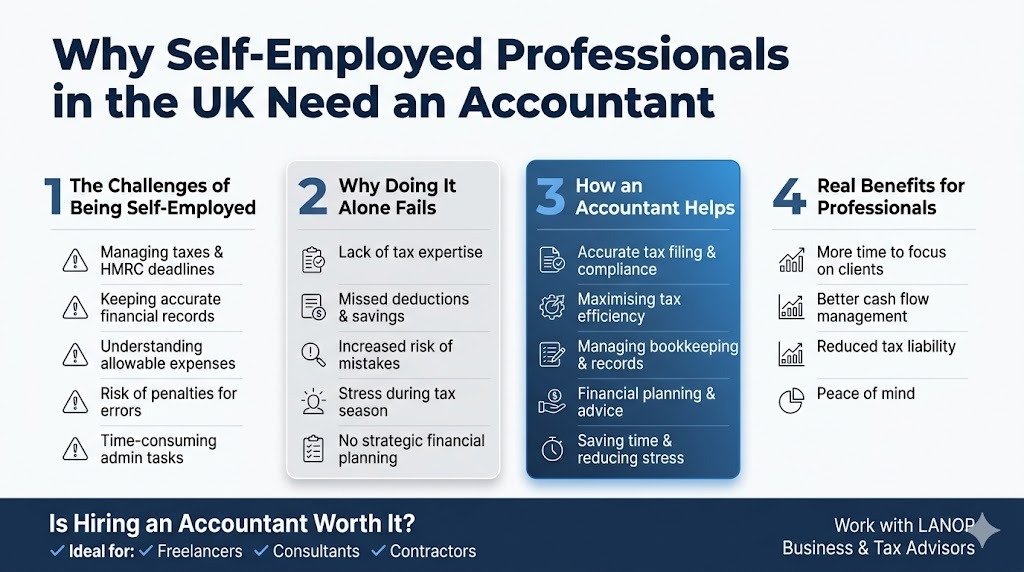
A good accountant is a partner in your business growth, not just a data entry clerk.
Core Services
- Self Assessment Preparation: Ensuring every box is ticked correctly and submitted on time.
- Tax Planning: This is the “strategic” part. It involves looking at your income and finding legal ways to minimize your tax liability before the tax year ends.
- Expense Optimisation: Reviewing your spending to ensure you are claiming for everything the law allows.
Beyond Compliance
An accountant provides cash flow guidance. They can tell you, “You can afford to invest in that new equipment in June,” or “You need to set aside more for your January tax payment because your October was so profitable.” They offer the peace of mind that allows you to sleep at night.
Cost of an Accountant vs. Value They Provide
Typical UK Costs
For a self-employed professional, a basic Self Assessment service can range from £200 to £600 per year. If you require ongoing monthly bookkeeping and VAT support, fees might be £50 to £150 per month.
The ROI Breakdown
Let’s look at the Return on Investment (ROI) using a simplified example. If an accountant costs you £500 a year, but they:
- Find £800 in allowable expenses you missed.
- Save you 15 hours of admin (valued at £50/hr = £750).
- Prevent a £100 late filing fee.
The total value created is:
$$\text{Value} = 800 + 750 + 100 = £1,650$$
$$\text{Net Gain} = 1,650 – 500 = £1,150$$
Self-Employed Accounting Workflow
To maintain control, you should follow a structured “Financial Operating System.”
Weekly Tasks
- Track Income: Ensure all invoices sent have been recorded.
- Record Expenses: Scan receipts immediately using an app (like Dext or QuickBooks).
Monthly Tasks
- Review Finances: Look at your Profit & Loss. Is your margin staying consistent?
- Estimate Tax: Set aside a percentage of your monthly income in a separate savings account (usually 25-30%).
Yearly Tasks
- Prepare Accounts: Collate all data for your accountant by April/May (don’t wait until January!).
- Plan for Next Year: Discuss your goals with your accountant to adjust your tax strategy.
Key Financial Areas You Must Stay On Top Of
Taxes & National Insurance
In the UK, you don’t just pay tax; you pay “Payments on Account.” If your tax bill is over £1,000, HMRC requires you to pay half of next year’s estimated tax in advance. This “double whammy” in your first successful year catches thousands of professionals off guard.
VAT Threshold Awareness
The VAT threshold is a rolling 12-month limit. You cannot just check it at the end of the year. If you go over £90,000 and fail to register, you are liable for the VAT you should have charged your customers out of your own pocket.
Record Keeping
You must keep your records for at least 22 months after the end of the tax year the tax return relates to. However, if you are an employer or have more complex affairs, the rule is generally 6 years.
Real-Life Scenarios
Scenario 1: I Just Became Self-Employed
- Advice: Register with HMRC as soon as possible. You don’t necessarily need a full-time accountant yet, but a one-hour setup session to choose the right software will save you a “cleanup” bill later.
Scenario 2: I’m Earning More Than Expected
- Advice: This is the “danger zone.” If your profit hits £50,000, you enter the Higher Rate tax bracket (40%). An accountant can help you restructure (perhaps into a Limited Company) to save thousands.
Scenario 3: I Missed a Deadline
- Advice: Don’t panic, but act fast. HMRC is more lenient if you approach them with a “reasonable excuse.” An accountant can act as your agent to negotiate and file the late return immediately to stop daily penalties.
Common Mistakes Self-Employed Professionals Make
- Mixing Personal and Business Finances: Using the same bank account for Netflix subscriptions and client payments makes bookkeeping a nightmare and increases the chance of missing business expenses.
- Not Saving for Tax: Treating your entire bank balance as “spending money” is the #1 cause of business failure in the UK.
- Ignoring VAT: Thinking the £90k limit applies to “profit.” It applies to turnover (total sales).
The Impact of Making Tax Digital (MTD)
The way self employed accounting works is changing. HMRC’s Making Tax Digital initiative will eventually require most self-employed people to keep digital records and provide quarterly updates instead of a single annual return.
This increased frequency makes having a professional accountant almost essential. The complexity of filing four times a year plus a final declaration is too much for most people to handle alongside their actual work. An accountant ensures your software is MTD-compliant and that your data is transmitted accurately every quarter.
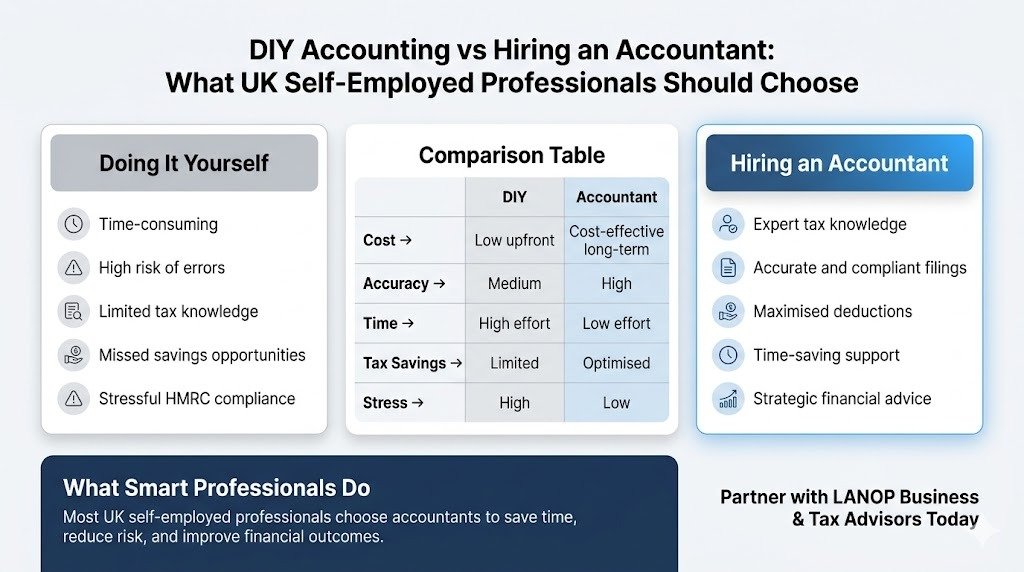
DIY vs. Software vs. Accountant
| Feature | DIY (Spreadsheets) | Accounting Software | Professional Accountant |
| Cost | Free | £10–£30 / month | £30–£100 / month |
| Accuracy | Low (Human error) | Medium (Automation) | High (Expert Review) |
| Tax Advice | None | None | Proactive Strategy |
| MTD Ready | No | Yes | Yes + Managed |
| Peace of Mind | Zero | Low | Total |
When to Get Expert Help
If you find yourself confused by tax codes, fearful of HMRC letters, or simply exhausted by the “Sunday night bookkeeping” routine, you shouldn’t wait. Growth adds complexity, and complexity leads to expensive mistakes.
At Lanop Business and Tax Advisors, we specialize in supporting UK self-employed professionals through every stage of their journey. From initial setup and HMRC registration to advanced tax planning and scaling, we provide a stress-free financial management service tailored to your specific industry.
We don’t just “do your books”we provide the structural clarity you need to focus on what you do best.
FAQS(Frequently Asked Questions)
Can’t I just manage my own taxes as a self-employed professional?
Technically yes, but the risks far outweigh the savings. HMRC’s Self Assessment system has many rules around allowable expenses, payment on account, and deadlines that are easy to get wrong without experience. A single mistake can result in penalties, interest charges, or an unwanted HMRC investigation. An accountant ensures everything is filed correctly and on time, giving you peace of mind.
How does an accountant actually save me money?
A good accountant does not just file your tax return, they actively look for ways to reduce your tax bill legally. They know which expenses you can claim, whether you should be VAT registered, and how to structure your income most efficiently. Many self-employed professionals save far more in tax than they pay in accountancy fees. It is less of a cost and more of an investment.
What happens if I miss a Self Assessment deadline?
HMRC issues an automatic £100 penalty the moment you miss the 31 January filing deadline, even if you owe no tax at all. After 3 months, daily £10 penalties begin to stack up, and after 6 months a further 5% surcharge is added to any tax owed. An accountant keeps track of all your deadlines and ensures nothing slips through the cracks. The cost of missing deadlines adds up very quickly.
I only freelance part-time. Do I still need an accountant?
Yes, because HMRC does not distinguish between full-time and part-time self-employment when it comes to your obligations. If your self-employed income exceeds £1,000 in a tax year, you must register for Self Assessment and file a return. Even on a small income, an accountant can make sure you are claiming everything you are entitled to and not overpaying tax. The fees for part-time support are usually very reasonable.
Can an accountant help me if HMRC investigates me?
Absolutely and this is one of the most valuable things an accountant provides. HMRC investigations can be stressful, time-consuming, and costly to handle alone, especially if your records are not in order. An accountant will communicate with HMRC on your behalf, organise your documentation, and protect your interests throughout the process. Having clean, well-maintained records from the start also significantly reduces your chances of being investigated in the first place.
How does an accountant help with planning for growth?
When your freelance income starts to grow, important decisions arise such as whether to incorporate as a limited company, how to handle VAT, or how to plan for your tax bill in advance. An accountant helps you think ahead rather than react, so you are never caught off guard by a large unexpected tax payment. They can also advise on pension contributions, dividend planning, and other strategies that become relevant as your earnings increase. Having that expert guidance early makes scaling your business far less stressful.
Final Thoughts
At Lanop Business and Tax Advisors, we understand that you can certainly manage your own self-employed accounting but you must ask yourself, at what cost? If you are trading your billable hours and your mental health for a few hundred pounds in accounting fees, it is simply a losing bargain. The right professional support saves you far more than it costs, protecting your time, reducing your tax bill, and ensuring your self-employed freedom does not come with a side of regulatory stress. At Lanop, we work with self-employed professionals across the UK to make sure their finances are clean, compliant, and working harder for them.
The earlier you bring in professional support, the easier your journey becomes whether you are just starting out or already growing a solid client base. Lanop Business and Tax Advisors offers tailored accountancy services designed specifically around the needs of self-employed professionals, from Self Assessment filing and expense planning to VAT advice and incorporation guidance. Our goal is simple: to give you the confidence to focus on your work while we take care of the numbers. Get in touch with the Lanop team today and let us build a financial foundation that grows with you.